
30.10.06

29.10.06
VII Jornadas de la SEMAC
VII Jornadas de la SEMAC
4 y 5 de Noviembre de 2006
Olesa de Bonesvalls
Los días 4 y 5 de Noviembre de 2006 se realizará una nueva jornada de trabajo de la SEMAC. La Federació Catalana d’Espeleología acoge estas jornadas y se encarga de la organización de las mismas. Se desarrollaran en el macizo del Garraf, cercano a Barcelona, que es un bello parque natural, magnífico exponente del karts mediterráneo.
Programa Científico:
- Nuevas aportaciones en relación al Síndrome del Arnés.
- Accidentes en el período 2006.
- Prevención de muertes inmerecidas en competición espeleo-indoor.
- Patología producida por el virus Chikungunya en las expediciones en Asia.
Taller Práctico en ambiente hipóxico,hipercápnico y normobárico. Encondiciones reales, en simas delmacizo del Garraf.
Full info: Fedespeleo.com
28.10.06
WWW.SPELEOGENESIS.INFO - BULLETIN no 15
NOW ONLINE - VOLUME 4, ISSUE 1, 2006
Tiankengs: Special Issue
The Speleogenesis Team is pleased to announce the release of the next issue of the "Speleogenesis and Evolution of Karst Aquifers" Journal – Volume 4, Issue 1. This is a special issue, a joint publication with Cave & Karst Science (vol.32, 2-3) and Carsologica Sinica (vol.25),
dedicated to tiankengs (giant dolines) in South China and elsewhere. This is a prime outcome from the 2005 Tiankeng International Investigation Project, organised by Prof. Zhu Xuewen and his team.
The volume contains twelve articles (see the content at the bottom) providing a comprehensive characterisation and discussion of the tiankeng phenomena and related aspects. The ultimate link between the formation of tiankengs and speleogenesis is well illustrated by the papers, as well as an important role of speleogenesis in karst geomorphology.
Previous issues of Speleogenesis are available via the "Jump to:" line on the main page. All previously published papers are available in the Archive section.
NEXT ISSUE IN PREPARATION – Volume 4, Issue 2, 2006
The Speleogenesis team is working on the next issue.
As always, the Journal relies on good papers. We encourage you to submit your contributions to be considered for publication.
EXPLORATION SPOTLIGHT
A new addition here is a brief info on the results of the most recent expedition of the "Call of the Abyss" project to Krubera Cave, Arabika, Western Caucasus (August-September 2006), with a new depth figure for the cave to be -2,158m. Snapshots from the updated 3D model of the cave are posted there.
Speleogenesis.info
Tiankengs: Special Issue
The Speleogenesis Team is pleased to announce the release of the next issue of the "Speleogenesis and Evolution of Karst Aquifers" Journal – Volume 4, Issue 1. This is a special issue, a joint publication with Cave & Karst Science (vol.32, 2-3) and Carsologica Sinica (vol.25),
dedicated to tiankengs (giant dolines) in South China and elsewhere. This is a prime outcome from the 2005 Tiankeng International Investigation Project, organised by Prof. Zhu Xuewen and his team.
The volume contains twelve articles (see the content at the bottom) providing a comprehensive characterisation and discussion of the tiankeng phenomena and related aspects. The ultimate link between the formation of tiankengs and speleogenesis is well illustrated by the papers, as well as an important role of speleogenesis in karst geomorphology.
Previous issues of Speleogenesis are available via the "Jump to:" line on the main page. All previously published papers are available in the Archive section.
NEXT ISSUE IN PREPARATION – Volume 4, Issue 2, 2006
The Speleogenesis team is working on the next issue.
As always, the Journal relies on good papers. We encourage you to submit your contributions to be considered for publication.
EXPLORATION SPOTLIGHT
A new addition here is a brief info on the results of the most recent expedition of the "Call of the Abyss" project to Krubera Cave, Arabika, Western Caucasus (August-September 2006), with a new depth figure for the cave to be -2,158m. Snapshots from the updated 3D model of the cave are posted there.
Speleogenesis.info
26.10.06
Nueva especie cavernícola, Catellón, Spain

La Comunitat Valenciana cuenta con una nueva especie, perteneciente a un nuevo género, única y endémica. Ha sido hallada en seis cavidades que van desde el sur de Tarragona y se extienden por las sierras costeras castellonenses de los términos de Sant Mateu, Coves de Vinromà y Cabanes hasta alcanzar la Serra d’en Galcerán.
Esta nueva forma de vida hasta ahora desconocida es el invertebrado hexápodo (de seis patas) cavernícola de mayor tamaño que habita el territorio peninsular. Sus dos centímetros y medio lo convierten en uno de los mayores depredadores de la fauna de las cavidades valencianas.
El hallazgo se produjo durante las exploraciones de diversas cavidades castellonenses llevadas a cabo por el personal del Museu Valencià d’Història Natural junto a miembros de la Universidad Alcalá de Henares, en el marco de los proyectos de investigación promovidos por la Conselleria de Territorio y Vivienda.
Su titular, Esteban González Pons, ha tachado este descubrimiento de “extraordinario, ya que se trata de una nuevo género para la Ciencia desconocido hasta ahora”.
Su aspecto grácil -posee un cuerpo y apéndices excepcionalmente alargados para el grupo zoológico al que pertenece- así como sus extraordinarias pinzas le confieren una morfología excepcional. Dentro de su grupo zoológico, este nuevo taxón representa el caso más evidente de adaptación al medio subterráneo que se conoce en todo el mundo.
González Pons ha asegurado que “en unos pocos meses, ésta nueva forma de vida será presentada a la comunidad científica en una revista especializada y, hasta entonces su nombre, por exigencias del Código Internacional de Nomenclatura Zoológica, no puede salir publicado en ninguna revista o medio de comunicación. Tan solo podemos adelantar la referencia del citado nombre a un conocido personaje mitológico relacionado con el mundo subterráneo”.
El conseller de Territorio ha asegurado que no es la primera vez que las cavidades castellonenses nos dan estas espectaculares sorpresas zoológicas. “De hecho, las sierras costeras de esta provincia albergan una fauna subterránea excepcional constituida, como este nuevo organismo, por un elenco de endemismos arcaicos considerados como verdaderos fósiles vivientes que sobreviven y pueblan buena parte de nuestras cavidades”.
La fauna cavernícola de la Comunidad Valenciana posee, como nos ha mostrado este nuevo descubrimiento, un incalculable valor que debemos saber preservar para el futuro. Especies que son la clave para conocer mejor nuestro pasado y la diversidad genética de nuestra fauna endémica. (...)
Esta nueva forma de vida hasta ahora desconocida es el invertebrado hexápodo (de seis patas) cavernícola de mayor tamaño que habita el territorio peninsular. Sus dos centímetros y medio lo convierten en uno de los mayores depredadores de la fauna de las cavidades valencianas.
El hallazgo se produjo durante las exploraciones de diversas cavidades castellonenses llevadas a cabo por el personal del Museu Valencià d’Història Natural junto a miembros de la Universidad Alcalá de Henares, en el marco de los proyectos de investigación promovidos por la Conselleria de Territorio y Vivienda.
Su titular, Esteban González Pons, ha tachado este descubrimiento de “extraordinario, ya que se trata de una nuevo género para la Ciencia desconocido hasta ahora”.
Su aspecto grácil -posee un cuerpo y apéndices excepcionalmente alargados para el grupo zoológico al que pertenece- así como sus extraordinarias pinzas le confieren una morfología excepcional. Dentro de su grupo zoológico, este nuevo taxón representa el caso más evidente de adaptación al medio subterráneo que se conoce en todo el mundo.
González Pons ha asegurado que “en unos pocos meses, ésta nueva forma de vida será presentada a la comunidad científica en una revista especializada y, hasta entonces su nombre, por exigencias del Código Internacional de Nomenclatura Zoológica, no puede salir publicado en ninguna revista o medio de comunicación. Tan solo podemos adelantar la referencia del citado nombre a un conocido personaje mitológico relacionado con el mundo subterráneo”.
El conseller de Territorio ha asegurado que no es la primera vez que las cavidades castellonenses nos dan estas espectaculares sorpresas zoológicas. “De hecho, las sierras costeras de esta provincia albergan una fauna subterránea excepcional constituida, como este nuevo organismo, por un elenco de endemismos arcaicos considerados como verdaderos fósiles vivientes que sobreviven y pueblan buena parte de nuestras cavidades”.
La fauna cavernícola de la Comunidad Valenciana posee, como nos ha mostrado este nuevo descubrimiento, un incalculable valor que debemos saber preservar para el futuro. Especies que son la clave para conocer mejor nuestro pasado y la diversidad genética de nuestra fauna endémica. (...)

24.10.06
Conexão Subterrânea nº 40 & SBE notícias nº 30
Nesta edição de Conexão Subterrânea os seguintes assuntos:
- Trabalhos conjuntos na Serra da Bodoquena
- Alerta aos exploradores do Vale do Ribeira
- Mapeadas grutas em Nova Esperança do Sul, RS
- A interessante Gruta da Capelinha, Cajati, SP
- GPME mapeia gruta histórica em Socorro, SP
- Escola Argentina de Espeleologia ministra o terceiro módulo de cursos
- Novo recorde de profundidade é alcançado no abismo de Renejevo brezno, Kanin, Eslovênia
- Lançado edital de apoio à revitalização do rio São Francisco
- Laboratório subterrâneo de microscopia
- Congresso internacional sobre Cavernas Graníticas será realizado na Espanha
- Homem pretende viver três anos numa caverna
Para obter os números anteriores: www.redespeleo.org.br
Esta edição do SBE notícias contém:
- Trabalhos conjuntos na Serra da Bodoquena
- Alerta aos exploradores do Vale do Ribeira
- Mapeadas grutas em Nova Esperança do Sul, RS
- A interessante Gruta da Capelinha, Cajati, SP
- GPME mapeia gruta histórica em Socorro, SP
- Escola Argentina de Espeleologia ministra o terceiro módulo de cursos
- Novo recorde de profundidade é alcançado no abismo de Renejevo brezno, Kanin, Eslovênia
- Lançado edital de apoio à revitalização do rio São Francisco
- Laboratório subterrâneo de microscopia
- Congresso internacional sobre Cavernas Graníticas será realizado na Espanha
- Homem pretende viver três anos numa caverna
Para obter os números anteriores: www.redespeleo.org.br
Esta edição do SBE notícias contém:
- Construção de barragens ameaça o património espeleológico;
- Turista encontra lança de pedra numa caverna próxima de Sydney, Australia;
- Tres anos nuna caverna;
- Novos registos de cavidades en RN;
- Novo livro do GEEP: Conhecendo Cavernas.
Boletim em formato .pdf em: http://www.sbe.com.br/sbenoticias/SBENoticias_030.pdf
23.10.06
Sotano De Las Golondrinas
Sótano de las Golondrinas was named after the numerous birds living in holes of the cavern wall. Golondrinas is the Méxican name for swallows. However, the birds of the cave are swifts (Apus apus), locally called vencejos and parrots (Aratinga holochlora), locally called Perico Quila or Cotorra de Cueva.
The cave is - amongst cavers - one of the most famous caves of the world. It is the second deepest entrance drop of the world, 376m deep, and a challenge for any caver. Going down the pit means a 20 mins. abseil to the bottom. A lot of energy transformed into heat, a problem for rope and abseil equipment.
But the way back is the real challenge! The caver has to climb up a single rope, using rope clamps, which is very exhausting. It is at least 40 mins of enormous exertion, even for extremely fit cavers a hard fight. For normal, physically fit people it more or less two hours of ascend.
And then there is psychology: the height of the cave is not the only problem, the width makes it look much easier and smaller than it really is. Our brain is not used to estimate this dimensions realistic, so the climber gets the impression to work really hard without any progression. The walls are too far away to show his movement.
The floor of the pit is covered with meters of dung from the millions of birds. This dung, the rainwater, and debris from the surface are the food base to numerous animals on the cave floor. There are millipedes and insects, snakes, and scorpions. The air is filled with smells, fungi and bacteria. It is possible to visit the floor without respiration mask, but cavers who want to explore the corners of the cave should bring such equipment. There is always the danger of Histoplasmosis and other diseases.
In the last years the cave became a sort of Mecca for base jumpers, parachutists and team building companies. This is rather positive for the locals, who had no other income until now, than their farming. They do not even have a regular road to the village, just a single lane track only suitable to 4WDs. But the increasing number of visitors also makes problems. Especially pollution is a serious problem.
To protect nature, the cavern and its unique ecosystem, the cavers agreed to use only one point at the rim for their descends. This place is equipped with bolts for the rope. Another point is the time of day, as the birds fly in and out of the cave at morning and evening. Typically they leave the cave at dawn and return at dusk. Cavers, and especially base jumpers, should avoid this time of day. (text from: ShowCaves)
Cave Jump
20.10.06
Kartchner Caverns a Microbial Observatory
University of Arizona researchers will investigate the lives of Kartchner Caverns State Park's tiniest inhabitants with the help of a $1.6 million grant from the National Science Foundation.
The five-year grant to the UA will add Kartchner Caverns, part of the Arizona State Parks system, to the National Science Foundation's worldwide network of Microbial Observatories. Research at the networks' sites is revealing the goings-on of the Earth's smallest and most poorly known life forms. Kartchner Caverns is the only cave in the network. "We thought Kartchner Caverns was perfect for this. It's one of the top 10 caves in the world in terms of mineralogical diversity," said principal investigator Raina M. Maier, a UA professor of soil, water and environmental science. "And the development of Kartchner is a model internationally for the development of a cave as a living system. It's a model for preservation." The researchers will catalog the microbial inhabitants of the cave, study how tourism affects their diversity and investigate whether microorganisms are involved in the growth of cave formations such as stalactites and stalagmites. The team also hopes to find microbes that could be exploited for medical, industrial and biotechnology applications. (...)
Full text: Uanews.org
International Conference On Granite Caves
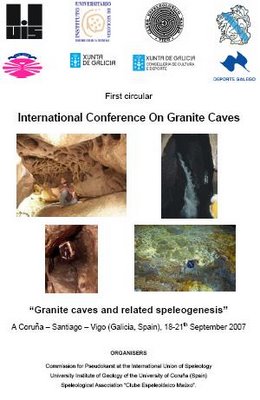
“Granite caves and related speleogenesis”
A Coruña – Santiago – Vigo (Galicia, Spain), 18-21th September 2007
ORGANISERS
Commission for Pseudokarst at the International Union of Speleology
University Institute of Geology of the University of Coruña (Spain)
Speleological Association “Clube Espeleolóxico Maúxo”.
PLACE, DATE AND THEME
The International Conference on Granite Caves will be held from September 19 to 21, 2007, at the University Institute of Geology of the University of Coruña, Galicia, Spain.
The theme will be “Granite caves and related speleogenesis”:
• Granite caves
o Technical speleology on granite caves
o Genesis and classification of granite caves.
o Mapping on granite caves
o Biospeleology on granite caves
o Archaeology: Men and caves.
• Speleothemes
o Opal speleothemes
o Pigotite and organic speleothemes.
o Allophane speleothemes
• Caves in related lithologies or :
o Caves in sandstone
o Caves in quartzite
o Caves in quartz
o Marine erosion caves
o Volcanic tubes
o Caves in other planets (Mars, ..)
Pre- and post-field trips and other activities will be held in areas of speleological and archaeological interest in several parts of Galicia, including the surroundings of A Coruña, Santiago de Compostela, Vigo and Baiona.
THE CONVENTION CENTER IN GALICIA
Preliminary registration form should be returned by e-mail or normal post to the Organising Committee before: 31.12.2006
E-mail address: xeoloxia@udc.es
Post address:
Secretariat – ICOGC Registration.
University Institute of Geology “Isidro Parga Pondal” of the University of Coruña.
Edificios de Servicios Centrales de Investigación
Campus de Elviña
15071 – A Coruña (SPAIN)
More information: 1st circular
19.10.06
PETZL: Stop use until inspected
Stop use until inspected
Ball-Lock carabiners product safety bulletinName of product: Am'D Ball-Lock, William Ball-Lock
Ball-Lock carabiners product safety bulletinName of product: Am'D Ball-Lock, William Ball-Lock
Clearfield, Utah (October 18, 2006) Petzl America voluntarily announced a recall of Petzl M34 BL Am'D BALL-LOCK and M36 BL WILLIAM BALL-LOCK carabiners with the new metal locking sleeve due to the possibility that the sleeve can be unlocked without pressing the green button, so the locking system acts as a TWIST-LOCK, instead of a BALL-LOCK. Affected units were sold during March and July, 2006. No incidents or injuries have been reported. This information does not apply to the older nylon-sleeve locking system, but only to BALL-LOCK carabiners with the metal locking sleeve manufactured in March and July, 2006. This recall is in effect only in the USA - it does not affect BALL LOCK carabiners sold in other countries (see press release - pdf format, 50 Kb).
Full information: Please check
16.10.06
Kanin, Slovenia : New record in Renejevo brezno
At 14th October 2006 the 3-person team from Speleo Club of Ljubljana (Dru?tvo za raziskovanje jam Ljubljana, DZRJL, Slovenia,) explored new part in Renejevo brezno on Kanin and reached the depth ?1215m and stopped by shortage of time and equipment. The active water collector, that was found last year, is near 1km long and goes on. This part of Renejevo brezno was explored in 4 weekend-action, by small teams with strong sport accent : vertical passages in total come over 1000 meters. You could see the plan of vertical part of Renejevo brezno on http://dzrjl.speleo.net/rene/rene-nacrt.jpeg .
Renejevo brezno is the second cave over 1000 m depth, explored by DZRJL. The first was Vandima, on Rombon`s part of Kanin, -1182m . DZRJL also explored Brezno pod velbom (-910m), which entrance vertical 501 m, is the 3th great vertical in the world. Renejevo brezno is doubtless the new great achievement of DZRJL.
by: J. Pirnat, informer of Kanin`s Caving Explorations, DZRJ Ljubljana, Slovenia, in Zenas.gr
15.10.06
Cavers hope to introduce management techniques to South African cave systems
"Words such as "awesome, fantastic, excellent and beyond our wildest dreams" come spilling out from three South African cavers as they prepared to descend into Parker Ranch Cave, located south of White's City.
The Parker Ranch Cave was the fourth cave the three men had visited since they arrived in New Mexico on Oct. 2, and they had several more to visit before heading back home Oct. 18.
Neil Norquoy, owner of Wild Cave Adventures in Krugersdorp, located near Johannesburg, South Africa; Stephen Greeff, a friend of Norquoy's and fellow caver; and Fredrick Van Der Merwe; a cave guide who works for Norquoy; said the trip to New Mexico is a fact-finding mission to learn about cave management from the federal agencies that manage public lands and the cave systems beneath the lands they manage.
They said the caves they have explored in New Mexico have been a great source of enjoyment.
"There is no comparison to the caves in New Mexico. They are spectacular," Norquoy said.
The trip to New Mexico to do some caving and learn about cave management came about in 2005 after a segment of the CBS reality series, "The Amazing Race," was filmed in the cave known as "Bat Cave" (...)"
From: Currentargus.com
14.10.06
Man to live three years in cave
An Italian sociologist has taken up residence in an underground cave, where he is hoping to spend the next three years of his life.
Maurizio Montalbini hopes his efforts will help scientists better understand the body's natural cycles.
The 53-year-old, who moved into his cave home on Wednesday, spent just over a year living in a cave in the 1990s.
Although he plans nourish himself with food pills, he has also brought supplies of honey, nuts and chocolate.
Caveman
Mr Montalbini, a keen caver, will drink water from a small pipe during the more than 1,000 days he will spend underground.
But he is not worried about missing out on lasagne. In fact he suspects the days will fly by too quickly.
"I've signed a letter authorising those who monitor me outside, my friends from the underground laboratory, Underlab, to let me spend three years in the grotto, no more," Mr Montalbini told Italy's La Repubblica newspaper.
In an earlier attempt, Mr Montalbini's sense of time was shifted by a lack of exposure to natural light.
"When I remained 366 days underground, I had the impression of only spending 219 days," he said.
"This is the last experiment I'm going to do, I'm getting too old for this," Mr Montalbini added.
The cave measures 2m (6.6ft) in width, 50m (164ft) in length and 5m (16.4ft) in height and is situated some 80m (262ft) underground.
It was not immediately clear which caves the sociologist had chosen for the experiment, but similar tests have taken place at caves in the Marche region of central Italy.
In an earlier attempt, Mr Montalbini's sense of time was shifted by a lack of exposure to natural light.
"When I remained 366 days underground, I had the impression of only spending 219 days," he said.
"This is the last experiment I'm going to do, I'm getting too old for this," Mr Montalbini added.
The cave measures 2m (6.6ft) in width, 50m (164ft) in length and 5m (16.4ft) in height and is situated some 80m (262ft) underground.
It was not immediately clear which caves the sociologist had chosen for the experiment, but similar tests have taken place at caves in the Marche region of central Italy.
From: News.bbc.co.uk
13.10.06

12.10.06
Icicle Formation Mystery Solved by Studying Stalactites

"Scientists have long understood how snowflakes take shape, but icicles have remained a wintry wonder.
A solution has finally emerged — from a cave.
In 2005, researchers determined that stalactites, the long, carrot-like structures that hang from ceilings of caves, have a distinctive shape that can be described by a simple mathematical equation.
Oddly, the same math applies to icicles, a new study shows.
Although stalactites and icicles have similar shapes, they don't have any physics in common.
Icicles grow from heat diffusion and rising warm air, while stalactites rely on the diffusion of carbon dioxide gas.
"We didn't expect to be able to apply the same math, because the physics of the two are so different," said mathematician and physicist Ray Goldstein of the University of Cambridge in England.
"It is really the same shape, apart from the bumps and wiggles," Goldstein added. "It confirms what we know with our eyes."
The findings were published in a recent issue of the journal Physics of Fluids.
The findings were published in a recent issue of the journal Physics of Fluids.
Icicles typically form on days when the outdoor air temperature is below freezing, but sunshine warms and melts some snow or ice.
As it drips off your roof, a water droplet loses heat to the cold air and eventually refreezes.
An icicle starts with a few frozen droplets. When it reaches a certain size, drops begin to drip down the sides of the structure.
"The water will run down the sides of the formation evenly, in a thin film, and freeze on the way down," said University of Arizona physicist Martin Short, another member of the study team. "This sort of freezing thin film of water is what leads to the eventual icicle shape."
The thin fluid layer on the surface of an icicle gives off heat that warms the air around it through a process called conduction.
As warm air rises, it removes heat from the liquid layer and causes it to freeze.
Here is the main point: The buffer of heated air is widest at the top of the icicle, where conduction is slowest.
"The buoyant air layer is really the most important factor in determining the icicle shape," Short told LiveScience.
Imagine the warm air as a blanket of differing thickness. The thinner part, at the bottom tip, allows more heat to escape than does the thick part of the blanket at the top.
"So the tip grows faster than the base, making the icicle pointy," Short explained.
The research was based on icicle photographs. To test their idea against actual icicles, the team plans to grow icicles in a lab and film their growth."
As it drips off your roof, a water droplet loses heat to the cold air and eventually refreezes.
An icicle starts with a few frozen droplets. When it reaches a certain size, drops begin to drip down the sides of the structure.
"The water will run down the sides of the formation evenly, in a thin film, and freeze on the way down," said University of Arizona physicist Martin Short, another member of the study team. "This sort of freezing thin film of water is what leads to the eventual icicle shape."
The thin fluid layer on the surface of an icicle gives off heat that warms the air around it through a process called conduction.
As warm air rises, it removes heat from the liquid layer and causes it to freeze.
Here is the main point: The buffer of heated air is widest at the top of the icicle, where conduction is slowest.
"The buoyant air layer is really the most important factor in determining the icicle shape," Short told LiveScience.
Imagine the warm air as a blanket of differing thickness. The thinner part, at the bottom tip, allows more heat to escape than does the thick part of the blanket at the top.
"So the tip grows faster than the base, making the icicle pointy," Short explained.
The research was based on icicle photographs. To test their idea against actual icicles, the team plans to grow icicles in a lab and film their growth."
Article & Photo from: FoxNews.com



11.10.06
Ecological Footprint

9 October: the day humanity starts eating the planet
New research reveals rising consumption of natural resources is pushing the world into ever earlier ecological debt, or ‘overshoot’
New calculations released today show that from now until the end of the year we will be living beyond our global environmental means. Research by the US-based Global Footprint Network in partnership with nef and Best Foot Forward reveals that as of today, humanity has used up what nature can renew this year and is now eating into its ‘ecological capital’.
Each year, the day that the global economy starts to operate with an ecological deficit is designated as ‘ecological debt day’ (known internationally as ‘overshoot day’). This marks the date that the planet’s environmental resource flow goes into the red and we begin operating on a non-existent environmental overdraft.
The fact that this year, ecological debt day falls on 9 October, only three quarters of the way through the year, means that we are living well beyond our environmental means. This leads, in effect, to a net depletion of the resources. From October 9 until the end of the year, humanity will be in ecological overshoot, building up ever greater ecological debt by consuming resources beyond the level that the planet’s ecosystems can replace.
This has been called, ‘the biggest issue you’ve never heard of,’ yet its causes and effects are simple and logical. If we eat more than we grow in any given year, we have to dip into reserves. If we cut trees faster than they grow back, then our forests become smaller than the year before. If we catch more fish than spawn each year, then there will be fewer fish in the sea.
The day that we begin living beyond our environmental means is creeping ever earlier in the year as human consumption grows:
New research reveals rising consumption of natural resources is pushing the world into ever earlier ecological debt, or ‘overshoot’
New calculations released today show that from now until the end of the year we will be living beyond our global environmental means. Research by the US-based Global Footprint Network in partnership with nef and Best Foot Forward reveals that as of today, humanity has used up what nature can renew this year and is now eating into its ‘ecological capital’.
Each year, the day that the global economy starts to operate with an ecological deficit is designated as ‘ecological debt day’ (known internationally as ‘overshoot day’). This marks the date that the planet’s environmental resource flow goes into the red and we begin operating on a non-existent environmental overdraft.
The fact that this year, ecological debt day falls on 9 October, only three quarters of the way through the year, means that we are living well beyond our environmental means. This leads, in effect, to a net depletion of the resources. From October 9 until the end of the year, humanity will be in ecological overshoot, building up ever greater ecological debt by consuming resources beyond the level that the planet’s ecosystems can replace.
This has been called, ‘the biggest issue you’ve never heard of,’ yet its causes and effects are simple and logical. If we eat more than we grow in any given year, we have to dip into reserves. If we cut trees faster than they grow back, then our forests become smaller than the year before. If we catch more fish than spawn each year, then there will be fewer fish in the sea.
The day that we begin living beyond our environmental means is creeping ever earlier in the year as human consumption grows:
- humanity first went into global ecological debt in 1987, with the first ecological debt day on 19 December that year;
- by 1995 it had jumped a month forward to 21 November;
- now, new estimates based on the latest available data indicate that in 2006, we run out of ecological resources today, Monday 9 October.
- by 1995 it had jumped a month forward to 21 November;
- now, new estimates based on the latest available data indicate that in 2006, we run out of ecological resources today, Monday 9 October.
Andrew Simms, nef’s policy director says: “By living so far beyond our environmental means, and running up ecological debts we make two mistakes. First, we deny millions globally who already lack access to sufficient land, food and clean water the chance to meet their needs. Secondly, we put the planet’s life support mechanisms in peril.”
Each year the Global Footprint Network calculates humanity’s Ecological Footprint - its total demand on nature’s ecosystems - and compares it with global biocapacity - the ability of ecosystems to replace resources and absorb wastes. Following an innovation by Footprint partner nef (the new economics foundation) this has been translated into a calendar year and the Footprint accounts used to determine the exact date when, as a global community, we begin to run our annual ecological deficit.
Mathis Wackernagel, Executive Director, Global Footprint Network says “Humanity is living off its ecological credit card and can only do this by liquidating the planet’s natural resources. While this can be done for a short while, overshoot ultimately leads to the depletion of resources, such as the forests, oceans and agricultural land upon which our economy depends.”
In other words, it now takes more than one year and three months for the Earth to regenerate what we use in a single year. The consequences of this ecological overshoot can be seen most seriously in our rapidly warming climate, but also in deforestation, the collapse of fisheries, species extinction, insecure energy supplies, water shortages and crop failure.
“The science of resource depletion is unequivocal. To deliver a sustainable future it is necessary to reduce demand, improve efficiency and switch to renewables. Calculating our global and personal resource depletion day is a resonant way of making planetary limits more transparent,” adds Craig Simmons, co-founder and director of Best Foot Forward another UK based footprint network partner.
Every year the ecological deficit contributes to an ever-accumulating global ecological debt. The price is often paid by those least responsible for the problem. The only way to balance the budget and end overshoot is to demand less of our planet.
We can however end overshoot by first keeping track of our resource use with tools like the Ecological Footprint, and then working to balance our ecological budget. We need to protect our ecosystems and improve their productivity, increase the efficiency of our resource use, and consume fewer resources per person where overconsumption is the norm. With each of these actions we can reduce our Ecological Footprint and decrease our ecological debt.
Climate change

We're organising the world's largest ever climate experiment, and we need your help. We need thousands of people to help.
Trying to predict climate change is hard. There are lots of factors involved – air temperature, sea temperature and cloud cover all play a part – as do dozens of other variables. Therefore, there are a huge number of calculations involved.
One solution is for scientists to use the largest supercomputer they can find. But even the biggest supercomputers are only so good.
We think you can do better.
Using a technique known as distributed computing, we’re hoping to harness the power of thousands of PCs around the world. If 10,000 people sign up, we’ll be faster than the world’s biggest computer. And we’re hoping to be even better than that.
Trying to predict climate change is hard. There are lots of factors involved – air temperature, sea temperature and cloud cover all play a part – as do dozens of other variables. Therefore, there are a huge number of calculations involved.
One solution is for scientists to use the largest supercomputer they can find. But even the biggest supercomputers are only so good.
We think you can do better.
Using a technique known as distributed computing, we’re hoping to harness the power of thousands of PCs around the world. If 10,000 people sign up, we’ll be faster than the world’s biggest computer. And we’re hoping to be even better than that.
All we’re asking you to do is download a simple programme, which doubles as a screensaver. Once you’ve installed it, your computer will take care of the rest. You don’t have to send us anything. You don’t have to enter any data. In fact – if you decide not set the programme as your screensaver, you probably won’t even notice it’s there.
However, if you want to, you can follow the progress of your experiment on a 3D spinning globe.
However, if you want to, you can follow the progress of your experiment on a 3D spinning globe.
Take part in the experiment
Donate your spare computing power and take part in the world's largest climate experiment. Find out why we need your help, and what we are hoping to find out.

About climate change
How does the greenhouse effect work? What's the evidence for climate change? Quiz: How much of an eco-warrior are you?
News stories on climate change from the BBC. Includes clips you can watch online.
10.10.06
40 years of Speleological Science
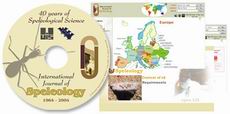
IJS CD-Rom: 40 years of Speleological Science
With the distribution of Volume 33 in 2004, a 40-year long cycle has come to an end.
The 40 year anniversary of the IJS raised the idea of making a memorial CD to be distributed during the 14th International Congress of Speleology in Athens (Greece) during 2005. In fact, it is difficult to find the entire IJS collection even in well known libraries, and this CD provides the opportunity - thanks to modern technology - for anyone to consult 40 years of Scientific Speleology.
This multimedia CD contains a database of all IJS volumes from number 1 (1/2) 1964 to number 33 (1/4) 2004 and the handbook MANUAL FOR KARST WATER ANALYSIS.
Order NOW!!!
7.10.06
Mallorca, bellezas en la oscuridad
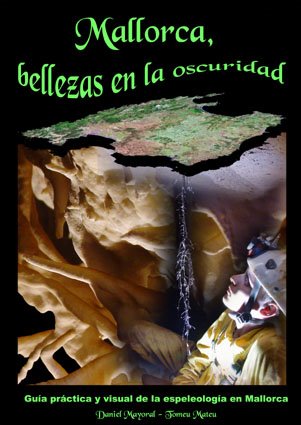 "Mallorca, bellezas en la oscuridad" es una guía práctica, distinta por sus innovaciones, compuesta por 16 de las más bellas cavidades Mallorquinas:
- Cova de Sa Campana Avenc de la Canal de la Coma Freda
- Cova des Coloms I Avenc d’en Corbera
- Cova de Cornavaques Avenc de s’Embut
- El Forat 502 Avenc de Fra Rafel
- Avenc des Gel Cova de Na Mitjana
- Cova de Cal Pesso Coves des Pont - Pirata
- Avenc des Portuguesos Cova de Les Rodes
- Cova Tancada des Cap de Menorca
Con descripción de accesos muy detallados con fotografías aéreas.
Croquis a escala con representación del camino por medio de puntos, tiempos, fotografías y coordenadas parciales.
Detalladas descripciones con grandes fotografías.
Ficha técnica de la instalación de la cueva
Ficha de material necesario para la instalación.
Topografías en 2D y 3D
Un avance de las últimas exploraciones en curso:
Cova de Sa Gleda, Cova des Coll y Cova des Pas de Vallgornera
Además de un CD con una recopilación de software, documentación, topografías y muchísimo material, de gran utilidad para el espeleólogo.
Compra online: http://www.espeleomallorca.com/
5.10.06
III Jornadas de Património e Desenvolvimento no Ambiente Cársico
III Jornadas de Património e Desenvolvimento no Ambiente Cársico
14 de Outubro de 2006
Centro de Estágios de Rio Maior
14 de Outubro de 2006
Centro de Estágios de Rio Maior

OBJECTIVOS DAS JORNADAS
- Promover a região e as suas potencialidades;
- Divulgar e valorizar o património cultural e ambiental;
- Valorizar o saber fazer, as técnicas artesanais e os ofícios tradicionais;
- Apresentar projectos modelo que tenham contribuído para a promoção e desenvolvimento local;
- Alertar para a necessidade de coordenação de esforços na área do Património;
- Desenvolver acções de parceria entre os vários agentes de desenvolvimento local;
- Definir estratégias e dinâmicas de desenvolvimento local, no âmbito do património.
III Jornadas de Património e
Desenvolvimento no Ambiente Cársico
Cov’Altas - Associação Cultural e Ambiental
Rua Brigadeiro Lino Valente, nº 13052380-608
Serra de Santo António
3.10.06
Nuno Gomes sofre acidente no Lago Garda

"O conhecido mergulhador Nuno Gomes, recorde mundial de mergulho autónomo, está sob tratamento dentro de uma câmera hiperbárica na cidade de Bolzano, norte da Itália, em condições críticas, após sofrer um acidente no final da manhã de hoje quando mergulhava nas águas do Lago de Garda. Gómez mergulhou na localidade de Capo Tempesta, poucos quilômetros ao sul de Torbole. O mal-estar se manifestou quando retornava à superfície, provavelmente por problemas de descompressão. Equipes locais socorreram o mergulhador, que estava consciente mas cujas condições aconselhavam a internação imediata em uma câmera hiperbárica, compartimento em que a pressão de oxigênio pode ser elevada acima da pressão atmosférica normal. O famoso mergulhador foi então transportado de helicóptero ao hospital da cidade italiana de Bolzano. O sul-africano Nuno Gomes é um dos mais famosos mergulhadores do mundo. Estabeleceu alguns recordes mundiais de mergulho profundo, como o de 282,6 metros na caverna de Boesmansgat, na África do Sul, em 1996. No ano passado, no Mar Vermelho, quebrou o recorde mundial de mergulho autônomo ao alcançar 318,25 metros."
FONTE: Ansa.it
SITE DE NUNO GOMES: http://www.nunogomes.co.za/
"Nuno Gomes had reached an averaged depth of - 282.6m - Cave Diving in Bushmansgat /South Africa"
1.10.06
Earth at Night

Credit: C. Mayhew & R. Simmon (NASA/GSFC), NOAA/NGDC, DMSP Digital Archive
Explanation: This is what the Earth looks like at night. Can you find your favorite country or city? Surprisingly, city lights make this task quite possible. Human-made lights highlight particularly developed or populated areas of the Earth's surface, including the seaboards of Europe, the eastern United States, and Japan. Many large cities are located near rivers or oceans so that they can exchange goods cheaply by boat. Particularly dark areas include the central parts of South America, Africa, Asia, and Australia. The above image is actually a composite of hundreds of pictures made by the orbiting DMSP satellites.
Subscribe to:
Posts (Atom)