31.7.06

La grotte la plus ancienne au monde

La grotte la plus ancienne au monde est âgée de 340 millions d'années
Par Christophe Olry, Futura-Sciences, le 27/07/2006 à 10h41


Jusqu’à aujourd’hui, la caverne empruntable à pieds la plus ancienne était située au Nouveau-Mexique. Elle remontait à 90 millions d’années. Elle vient d’être détrônée par les grottes de Jenolan, dont l’âge a été estimé à… 340 millions d’années !

La découverte, présentée dans l’Australian Journal of Earth Sciences, est le fruit d’Armstrong Osborne et de son équipe de l’université de Sydney. Les grottes de Jenolan, un site visité par de nombreux touristes tout au long de l’année, et que l’on pensait âgées de seulement quelques milliers d’années, sont en réalité les plus anciennes au monde. Elles datent de la période Carbonifère, entre 350 et 290 millions d'années avant notre ère.

Ainsi, ces cavernes situées à l’ouest de Sydney existaient bien avant que les dinosaures ne foulent la Terre et que les Montagnes bleues – Blue Mountains - ne se dessinent en Australie.

Pour déterminer l’âge des grottes de Jenolan, les chercheurs ont eu recours à une technique de datation traditionnellement utilisée par les compagnies pétrolifères pour trouver des gisements d'or noir. Ils ont prélevé des échantillons d’argile et ont mesuré leur teneur en potassium radioactif. C’est ainsi qu’ils ont eu la surprise de constater que les roches qui les entouraient étaient vieilles de 340 millions d’années. « Personne n’avait imaginé cela. Nous avons la preuve que l’argile s’est formé sur place, à l’intérieur de la caverne, et que les sites fréquentés régulièrement par les touristes datent de la période Carbonifère ! » a déclaré Horst Zwingmann, du CSIRO Petroleum Resources.

Cette découverte a relancé l’intérêt que les scientifiques portent aux grottes de Jenolan. Ils sont actuellement à la recherche d’événements géologiques qui auraient pu leur échapper. Leur première piste : l’argile pourrait bien s’être formé après que des cendres volcaniques aient pénétré dans la caverne. Les grottes de Jenolan réservent peut-être aux chercheurs d’autres surprises…

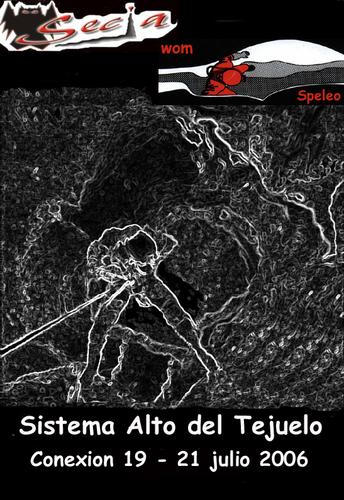
Spain: Sistema del Alto del Tejuelo = 77 km!


On the 20th of July a group of cavers from SECJA (Alcobendas, Madrid, Spain), WOM (Leuven, Belgium) and ACE Mataró (Mataró, Catalunya) made the connection between the Torca De Bernallán and Cueva de Los Moros.

The resulting cave system, Sistema del Alto del Tejuelo has a developpment of 77,577 km and a depth of 605 meter, and is thereby the largest known cave system of Cantabria and the second of Spain (after Ojo Guareña) ...

Besides Bernallán and Los Moros other caves included in the system are: Canto Encaramado (explored in the early '90's by AER Ramales), Torca de La Canal-Riañon (explored by SCD Dijon) and Cotero (explored by ACE Mataro)....

The connection between Canto Encaramado and Bernallán on the one side and La Canal and Los Moros-Cotero on the other side was realised some years ago...

Dirk Hermans - SECJA/ WOM

from: WCN

Kija Blue 2006 Expedition

Hi There Fellow Explorers !

I am very pleased to provide this quick report to let you know that our expedition to Kija Blue was highly successful with all dives being conducted safely and effectively. Better news still, there is more exploration and leads to pursue in this incredibly beautiful, deep and remote cave diving site in Australia's North West, or Kimberley region.

The team spent ten days on site and explored the underwater perimeter of the sinkhole to a depth of over 110m, making this Australia's second deepest cave diving site after The Shaft at Mt Gambier (126m). There are leads at the deepest level of Kija Blue which may yet see this being the deepest Australian cave diving site. Tentative plans are already being made for a return trip next year to investigate this!

Being located in a tropical area, the massive rainfall of the 2005/2006 Wet Season had a significant impact on the site, altering the distribution of aquatic plantlife in the lakes as well as the size and shape of floor pits seen at 65m depth in the Colossal Room. The water level was significantly higher than our visit in 2005 and the lake water level was measured to drop by 30mm every day as it feeds nearby surface springs. A number of aquatic fauna species were collected for identifiaction by the WA Museum, including some unusual, tiny, hermit crab-like creatures.

More than one kilometre of additional passages were surveyed on this trip, with more than 60% of that at depths in excess of 60m. Ken Smith's newly modified Deep Pingers were used to locate accurate surface positions for 13 different survey points, including some as deep as 100m.

It should be noted that the exploration of this deep cave diving site would not have been possible without the use of closed circuit rebreathers. The logistics of transporting the necessary open circuit gas to the sinkhole would have been cost-prohibitive (as it was, the team members laid out at least $3000 each to complete this trip).

The next step is for the map to be compiled from all the survey and pinger data collected. This will be followed by full trip reports and articles for publication. For more information and some photos from this trip, please see http://www.trimixdivers.com and follow the links to the Kija Blue 2006 Expedition.

Kindest Regards and Safe Diving,

Paul Hosie
Trip Leader
Western Australian Speleological Group
Australian Speleological Federation - Cave Diving Group

FUENTE AZUL -135 M

FUNTE AZUL
más profundo


Martín Burgui –135 m


Las inmersiones en esta fuente vauclusiana, que drena el agua quizás de un acuífero cautivo a través de una falla, no cesan. El domingo 30 de julio, el buceador vasco Martín Burgui ha tocado los 135 m de profundidad.
En esta inmersión han participado con Martín los buzos: Dani Santamaría, Amaia Olea, Álvaro Subiñas (Subi) y Oscar Carrión.

19.7.06

Férias


O Blog Profundezas... foi de férias, volta em Agosto!

Até lá.


" A exploração do mundo subterrâneo e o seu conhecimento constituem uma aventura sem fim."

Michel Bouillon

17.7.06

REBREATHER

¿Qué es un REBREATHER?

Para entender lo que es un REBREATHER y como funciona, es útil entender como funciona un equipo de buceo convencional (Circuito Abierto). Con este sistema un buceador solo usa una pequeña fracción del oxígeno de cada inspiración; cuando el buceador expira, la mayor parte del oxígeno abandona los pulmones sin ser usado. El oxígeno y otros gases son desechados en forma de burbujas. Al aumentar la profundidad del buceador, debido al aumento de la presión, más moléculas de gas se pierden con cada expiración. Un REBREATHER en cambio, retiene la mayor parte o incluso todo el gas expirado, lo procesa, y lo devuelve al buceador. En el caso de los REBREATHERS de Circuito-Cerrado, como no hay prácticamente ninguna burbuja expirada, no varía la eficiencia del uso del gas a profundidades superiores. Por lo tanto, cuanto más profunda sea la inmersión, más ventajoso (desde la perspectiva de la eficiencia del gas) es el REBREATHER.


¿Cuándo aparecieron los primeros REBREATHERS?
Muy contrariamente a lo que la gente cree los REBREATHERS no son nada nuevo. El primero es de Henry A. Fluess 1878. Es decir, 65 años antes que el regulador Cousteau-Gagnan 1943.


Tipos de REBREATHER
Hay tres tipos básicos de REBREATHERS: Cerrado de oxígeno, semi-cerrado (Semi-Closed), y rebreather de circuito-cerrado (Closed-Circuit). Cada uno tiene sus ventajas y desventajas específicas.

(...)

Full article: Espeleoastur.as
More information: Hmdiver.com

15.7.06

Identification of cave minerals by Raman spectroscopy

Identification of cave minerals by Raman spectroscopy: new technology for non-destructive analysis
William B. White


"The identification of minerals from caves generally requires that samples be removed from the cave for analysis in the laboratory. The usual tools are X-ray powder diffraction, the optical microscope, and the scanning electron microscope. X-ray diffraction gives a definitive fingerprint by which the mineral can be identified by comparison with a catalog of reference patterns. However, samples must be ground to powder and unstable hydrated minerals may decompose before analysis is complete. Raman spectroscopy also provides a fingerprint useful for mineral identification but with the additional advantage that some a-priori interpretation of the spectra is possible (distinguishing carbonates from sulfates, for example). Because excitation of the spectra is by means of a laser beam, it is possible to measure the spectra of samples in sealed glass containers, thus preserving unstable samples. Because laser beams can be focused, spectra can be obtained from individual grains. New technology has reduced the size of the instrument and also the sensitivity of the optical system to vibration and transport so that a portable instrument has become possible. The sampling probe is linked to the spectrometer by optical fibers so that large specimens can be examined without damage. Comparative spectra of common cave minerals demonstrate the value of Raman spectra as an identification technique."

The distribution of diatom flora in ice caves

The distribution of diatom flora in ice caves of the northern Yukon Territory, Canada: relationship to air circulation and freezing

Bernard Lauriol1, Clément Prévost and Denis Lacelle

"In the late 1980’s and early 1990’s, various media in karst environments in the Northern Yukon Territory were examined for their diatom content. Cryogenic cave calcite powders, grus and various ice formations (ice plugs, ice stalagmites and floor ice) were collected from three freezing caves and one slope cave to make an inventory of the diatom content, and to explain the spatial distribution of the diatoms within the caves. The results show that approximately 20% of diatoms in the caves originate from external biotopes and habitats (e.g., river, lake, stream), with the remaining 80% of local origin (i.e., from subaerial habitats near cave entrances). The results also indicate that the greater abundance of diatoms is found in the larger caves. This is explained by the fact that the air circulation dynamics are much more important in caves that have a larger entrance. Also grus, ice plugs and ice stalagmites have the lowest diatom diversity, but greater relative abundance, indicative of growth in specific habitats or under specific conditions. Overall, these results are a contribution to the study of particles transport in ice caves."

International Journal of Speleology


Volume 35 (2) - Year 2006

The new issue 35(2)(July 2006) of the International Journal of Speleology is out.
Come and look at the new A4 format , layout and style and see the contents.

14.7.06

CATÁLOGO DAS CAVIDADES VULCÂNICAS DOS AÇORES

O “Catálogo das Cavidades Vulcânicas dos Açores – Grutas Lávicas, Algares e Grutas de Erosão Marinha” foi apresentado à comunidade científica no ultimo fim de semana durante o “XII International Symposium on Vulcanospeleology”, realizado entre 2 e 8 Julho em Tepotzotlán, México.
Tratou-se do pré-lançamento de uma obra que compila, ao longo de cerca de 300 páginas, todas as cavidades vulcânicas do arquipélago. Editado pela Secretaria Regional do Ambiente e do Mar, o livro deverá ser lançado oficialmente em inícios de outubro do corrente ano.
Ao todo, são listadas 250 grutas e algares dos Açores. Segundo os autores, esta obra “pretende ser um marco no conhecimento do patrimônio vulcanoespeleológico dos Açores.
Para 100 das cavidades são apresentadas topografias detalhadas e fotografias.
A informação é disponibilizada em forma de fichas, nas quais constam além do nome e dos sinônimos conhecidos, a sua posição, comprimento e profundidade, descrição geral, características geológicas principais, interesse biológico, além das principais referências, mapa com a posição da caverna nas correspondentes ilhas.
O catálogo compreende uma extensa lista da fauna e flora conhecidas em cada uma das cavidades.